


Sleep Apnea Oral Appliances: How Comfortable Are They Really?
Real Patient Experiences, What the Research Says, and How to Find the Right Fit for You
If you’ve been diagnosed with sleep apnea and your doctor has mentioned a mandibular
advancement device (MAD) or oral appliance therapy, one of the first questions you probably
have is: will I actually be able to sleep in this thing? Comfort matters more than most people
realize, especially for a treatment you need to use every single night. The good news is that
today’s oral appliances are more refined than ever, and most people do adapt. But let’s be
honest about what the adjustment looks like.
What exactly is a sleep apnea mouth device, and how does it work?
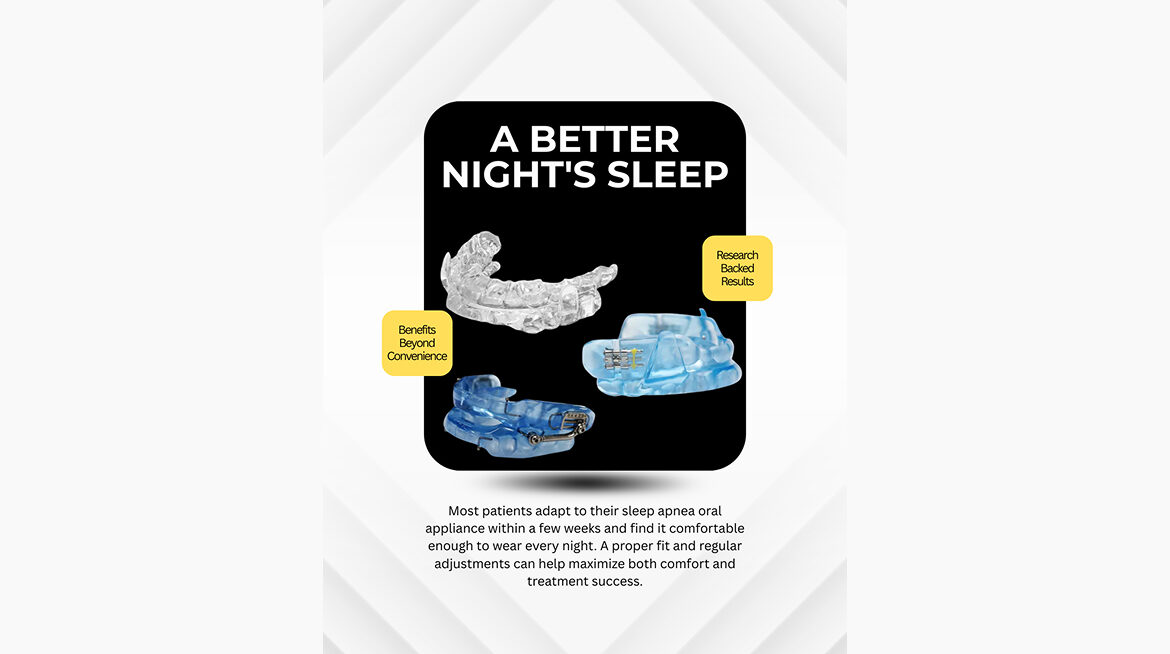
A sleep apnea mouth device, commonly called a mandibular advancement device (MAD) or oral
appliance, is a custom-fitted dental appliance worn during sleep. It works by gently
repositioning your lower jaw slightly forward, which keeps the airway open and prevents the
soft tissue collapse that causes obstructive sleep apnea (OSA) episodes.
These devices look somewhat like a sports mouthguard, but they are far more precise. They are
typically made from medical-grade acrylic or thermoplastic, and unlike over-the-counter
versions, a dentist-fitted appliance is calibrated specifically to the anatomy of your mouth, jaw,
and bite.
The American Academy of Sleep Medicine (AASM) recommends oral appliance therapy as a
first-line treatment for mild to moderate OSA and as an alternative for patients who cannot
tolerate CPAP (Ramar et al., 2015).
Is it normal to feel discomfort when first wearing one?
Yes, and this is one of the most important things to know going in. Almost all new users
experience some degree of initial discomfort, but this is very different from chronic, ongoing
pain.
Common early sensations include:
- Soreness in the jaw, teeth, or gums
- Increased salivation
- A feeling of jaw tightness in the morning
- Mild tooth sensitivity
A study published in Sleep and Breathing found that while initial discomfort was reported by a
majority of users, most patients rated their devices as comfortable after the four-week mark
(Marklund et al., 2004). The adaptation window for most people is two to four weeks.
If discomfort persists beyond six weeks or significantly disrupts sleep, that is a signal to return
to your dental sleep provider for an adjustment.
How does comfort compare to CPAP therapy?
CPAP is highly effective at treating sleep apnea, but comfort and adherence are significant
challenges. Patients often report issues with mask pressure, air leaks, noise, and
Claustrophobia.
Oral appliances consistently show higher adherence rates in clinical studies. A meta-analysis
published in the Journal of Clinical Sleep Medicine found that patients used oral appliances for
significantly more hours per night compared to CPAP, largely because they were easier to
integrate into daily routines (Sutherland et al., 2014).
That said, CPAP remains superior in reducing the apnea-hypopnea index (AHI) for severe OSA
cases. The right choice depends on your diagnosis severity, lifestyle, and tolerance, which is
why a thorough consultation with both a sleep physician and a dental sleep specialist matters.
What factors most influence how comfortable an oral appliance feels?
Not all oral appliances are created equal. Several factors directly affect how well you tolerate
Yours:
Custom Fit vs. Over-the-Counter A dentist-fabricated device uses detailed impressions of
your teeth and a precise jaw registration. This level of customization dramatically reduces
pressure points and soreness compared to boil-and-bite versions.
Device Design Some devices have two separate trays connected by adjustable hardware, which
allows your provider to modify the degree of jaw advancement over time. This gradual approach
lets your muscles adapt slowly and tends to minimize discomfort.
Material Quality Higher-quality medical acrylic is thinner, lighter, and more durable. Some newer appliances are 3D-printed from digital scans, offering an even more precise fit. Provider Expertise A dentist with specialized training in dental sleep medicine will account for your bite, temporomandibular joint (TMJ) health, and any pre-existing dental conditions when designing your appliance. This expertise makes a measurable difference in long-term comfort (Ngiam et al., 2013).
Can wearing the device cause jaw pain or TMJ problems?
This is a legitimate concern. Since MADs hold your jaw in a forward position for hours at a time,
there is some strain on the jaw muscles and temporomandibular joints, particularly early in
Treatment.
Research shows that TMJ-related side effects, including morning jaw soreness and limited
mouth opening, are common in the short term but generally mild and reversible (Doff et al.,
2013). Long-term, significant TMJ complications are uncommon when the device is properly
fitted and titrated.
To reduce this risk:
- Start with a conservative advancement setting and gradually increase it
- Use morning jaw stretches recommended by your provider
- Attend regular follow-up appointments, especially in the first three months
- Report any worsening jaw pain or clicking sounds promptly
Patients with pre-existing TMJ disorders should disclose this during their evaluation so the
provider can factor it into the treatment plan.
How long does it take to fully adjust?
Most patients move through three general phases:
- Weeks 1 to 2: Getting used to the presence of the device. Some disrupted sleep is
normal. Saliva production is often higher. - Weeks 3 to 4: Jaw soreness begins to decrease. Sleep quality often improves noticeably
as the airway benefit kicks in. - Weeks 5 to 8: Most patients report the device feeling like a natural part of their sleep
routine.
A clinical review in the Journal of Prosthodontic Research noted that patient compliance and
comfort ratings both improve substantially after the first month, and that early discomfort is
not a reliable predictor of long-term success (Ramar et al., 2015). In other words, pushing
through the first few weeks is usually worth it.
Are there tips to make wearing the device more comfortable?
A few practical habits make a meaningful difference:
- Wear it consistently, even on nights when you feel tempted to skip. Inconsistent use
prolongs the adaptation phase.
- Clean the device every morning with a soft toothbrush and mild soap or the cleanerrecommended by your provider.
- Store it in its case with a small amount of water to prevent warping.
- Do gentle morning jaw stretches or massage to ease muscle tension after removal.
- Attend all follow-up appointments so advancement can be fine-tuned based on howyour jaw responds.
If you experience morning tooth soreness that lasts more than an hour, mention it to your
provider. This can often be addressed with a slight reduction in jaw advancement, or by
checking for nighttime clenching that may need to be managed separately.
Is the treatment effective enough to make the adjustment period worthwhile?
For the right patient, yes. Multiple high-quality studies confirm that custom oral appliances
significantly reduce the apnea-hypopnea index (AHI), improve blood oxygen saturation, reduce
snoring, and lead to measurable improvements in daytime alertness and quality of life
(Sutherland et al., 2014).
A randomized controlled trial published in the New England Journal of Medicine found that for
patients with mild to moderate OSA, outcomes with oral appliances were comparable to CPAP
in terms of patient-reported quality of life, even though CPAP showed a slightly superior AHI
reduction (McEvoy et al., 2016).
Untreated sleep apnea carries serious long-term risks, including elevated blood pressure,
increased cardiovascular risk, impaired glucose metabolism, and diminished cognitive function.
For most patients, a few weeks of adjustment discomfort is a small price compared to those
Consequences.
Ready to Find Out If an Oral Appliance Is Right for You?
Comfort is highly individual, and the best way to understand what your experience will look like
is to start with a comprehensive dental sleep evaluation. A trained provider can assess your
airway anatomy, review your sleep study results, and help you choose an appliance that fits
your lifestyle and gives you the best chance of long-term success.
Oral appliance therapy is not a one-size-fits-all solution, but for millions of people, it has
become the treatment they actually use every night because it is comfortable enough to stick
with. That consistency is what drives real results.
If you have been putting off treatment because of concerns about comfort or convenience, this
is a good time to take the next step.