




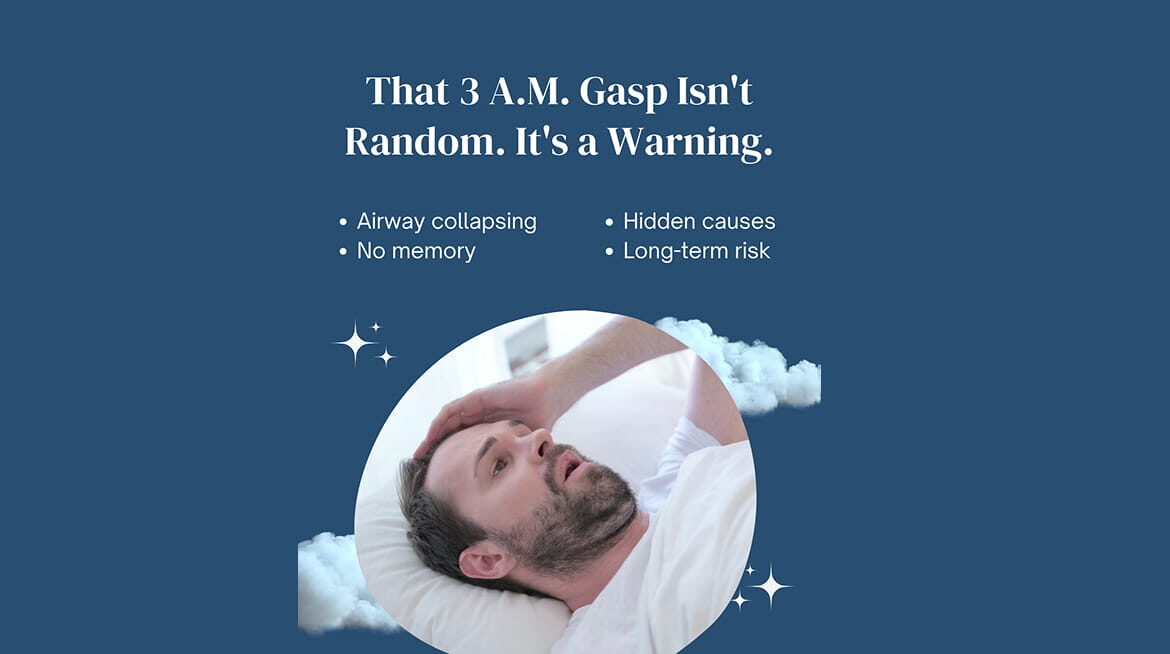
Why You Wake Up Gasping for Air at Night: Causes, Risks, and What to Do Next
Your nightly struggle to breathe may not be random. Here is what science says is actually happening, and what you can do about it.
Waking up suddenly, heart pounding, throat tight, and gasping for air is one of the most frightening experiences a person can have in their own bed. Many people brush it off as a bad dream or a fluke. But if it keeps happening, your body is sending a signal that deserves real attention.
This article answers the most common questions people have about waking up gasping or choking during sleep, backed by current research, and written for anyone who wants clarity over confusion.
Understanding Why You Wake Up Gasping or Choking in Your Sleep
Is it normal to wake up gasping or choking in your sleep?
Waking up occasionally with a start is fairly common and often harmless. But waking up gasping, choking, or struggling to breathe on a regular basis is not something to ignore. This pattern is one of the hallmark signs of obstructive sleep apnea (OSA), a condition in which the airway partially or fully collapses during sleep, briefly cutting off the oxygen supply. The brain then triggers an arousal response to restore breathing. The American Academy of Sleep Medicine estimates that OSA affects roughly 26% of adults between the ages of 30 and 70 in theUnited States alone (Peppard et al., 2013).
If it is happening more than occasionally, or if someone else has noticed you stopping breathing during sleep, a clinical evaluation is warranted.
What is actually happening in the body when you wake up gasping?
When you fall asleep, your throat muscles relax. In people with sleep apnea or other airway issues, that relaxation causes the soft tissue at the back of the throat to collapse inward, blocking airflow.
As oxygen levels in the blood drop and carbon dioxide builds up, the brain detects a threat and partially wakes you, often with a surge of adrenaline. This is why gasping episodes are frequently accompanied by a racing heart, disorientation, or a sense of panic. The entire episode may last only a few seconds, but the disruption to sleep architecture and cardiovascular function accumulates over time (Dempsey et al., 2010).
Importantly, many people have no memory of these events in the morning, which is one reason sleep apnea often goes undiagnosed for years.
What conditions can cause waking up gasping, beyond sleep apnea?
Sleep apnea is the most common culprit, but several other conditions can produce the same symptom:
Gastroesophageal reflux disease (GERD): Stomach acid can travel up into the esophagus or throat while you are lying flat, triggering a choking sensation or coughing that wakes you abruptly. Research has found that nocturnal GERD symptoms are significantly associated with sleep disturbances including arousals and awakenings (Lagergren et al., 2000).
Laryngospasm: An involuntary spasm of the vocal cords that temporarily closes the airway. These episodes are alarming but typically brief and self-resolving.
Heart failure or pulmonary edema: Fluid can accumulate around the lungs in people with cardiac conditions, causing sudden breathlessness when lying flat. This is known as paroxysmal nocturnal dyspnea and requires prompt medical attention.
Post-nasal drip or allergies: Mucus draining into the throat during sleep can produce a choking or gagging sensation that wakes you.
Nocturnal panic attacks: Some individuals experience anxiety-driven episodes during sleep that closely mimic the physical sensations of a breathing emergency.
The only way to accurately identify the cause is through a proper clinical evaluation, which may include a sleep study.
How do you know if it is sleep apnea specifically?
Sleep apnea has several distinguishing features beyond gasping at night. The most telling signs include:
- Loud, persistent snoring, especially if others have noticed pauses in your breathing
- Waking with a dry mouth or sore throat
- Morning headaches caused by overnight drops in blood oxygen
- Excessive daytime sleepiness even after a full night in bed
- Difficulty concentrating or memory lapses throughout the day
The gold standard for diagnosis is a polysomnography (PSG) study, conducted either in a sleep lab or through a validated home sleep apnea test. These tests measure respiratory effort, blood oxygen saturation, airflow, and sleep stages to calculate the apnea-hypopnea index (AHI), which reflects the number of breathing disruptions occurring per hour (Berry et al., 2012).
An AHI of 5 to 14 events per hour is classified as mild, 15 to 29 as moderate, and 30 or more as Severe.
Are certain people more at risk for this?
Yes. While sleep apnea and nocturnal breathing disruptions can affect anyone, several factors increase the likelihood:
Anatomy: A narrow airway, enlarged tonsils or adenoids, a recessed jaw, or a thick neck circumference all create physical conditions where airway collapse is more likely.
Weight: Excess tissue around the neck and upper airway is one of the strongest modifiable risk factors. Research published in JAMA found that a 10% weight gain was associated with a six-fold increase in the odds of developing moderate-to-severe sleep apnea (Peppard et al., 2000).
Age: Muscle tone in the throat naturally decreases over time, making airway collapse more common in older adults.
Sex: Men are diagnosed with OSA at roughly twice the rate of premenopausal women, though that gap narrows significantly after menopause (Young et al., 2002).
Alcohol and sedative use: Both relax throat muscles and suppress the brain’s arousal response, making apnea episodes longer and oxygen drops more severe.
Smoking: Increases inflammation and fluid retention in the upper airway, raising OSA risk Considerably.
What are the long-term health consequences if this goes untreated?
Untreated sleep apnea does not just disrupt your nights. It creates a cascade of health consequences that extend into every waking hour.
Cardiovascular disease is among the most serious. Repeated overnight drops in oxygen raise blood pressure, trigger inflammatory responses, and place sustained stress on the heart. A landmark study found that severe untreated sleep apnea significantly increased the risk of fatal and nonfatal cardiovascular events compared to those who received treatment (Marin et al., 2005).
Beyond the heart, untreated OSA has been associated with:
- Type 2 diabetes and insulin resistance (Punjabi et al., 2004)
- Increased risk of stroke
- Depression and mood instability
- Cognitive decline and memory impairment
- Motor vehicle accidents stemming from chronic daytime drowsiness
The American Heart Association now recognizes sleep apnea as a modifiable cardiovascular risk factor, reinforcing why treatment is not optional for those with confirmed diagnoses (Somers et al., 2008).
What treatment options are available?
Treatment depends on the underlying cause, severity, and individual health profile, but several evidence-based options exist:
Continuous Positive Airway Pressure (CPAP): The most well-established treatment for moderate-to-severe OSA. A CPAP device delivers a steady stream of pressurized air through a mask, keeping the airway open throughout the night. Modern machines are quieter and more comfortable than earlier generations, and adherence has improved significantly with auto-adjusting pressure technology.
Oral Appliance Therapy (OAT): Custom-fitted mouth devices that reposition the jaw or tongue to prevent airway collapse. These are particularly effective for mild-to-moderate OSA and for patients who cannot tolerate CPAP (Ramar et al., 2015).
Positional therapy: Some people experience apnea primarily when sleeping on their back. Encouraging side-sleeping through positional devices or wedge pillows can meaningfully reduce breathing events.
Weight management: For those with obesity-related OSA, even modest weight loss can significantly reduce apnea severity. A randomized controlled trial found that very low energy diet interventions produced substantial reductions in AHI among obese men (Johansson et al., 2009).
Surgical intervention: Procedures such as uvulopalatopharyngoplasty (UPPP), tonsillectomy, or maxillomandibular advancement may be appropriate for specific anatomical contributors, though outcomes vary by patient.
Addressing contributing conditions: If GERD, allergies, or nasal congestion are the primary drivers, treating those conditions directly often reduces or eliminates nocturnal choking episodes.
When should you see a doctor, and what should you tell them?
Seek evaluation sooner rather than later if:
- You wake up gasping or choking more than occasionally
- A partner has witnessed you stop breathing during sleep
- You feel unrested despite spending adequate time in bed
- You are dealing with persistent morning headaches, unexplained fatigue, or mood
changes
Start with your primary care physician, who can assess your symptoms and refer you to a sleep specialist or otolaryngologist as appropriate. A sleep study will typically follow. When you arrive, be prepared to describe the frequency and nature of your nighttime episodes, your general sleep habits, any medications you currently take, and relevant medical history. The more specific you are, the faster you reach an accurate diagnosis and a plan that works.
This is not overreacting. Sleep is the foundation of everything your body does to heal, regulate, and function. Protecting it is one of the most meaningful health decisions you can make.
The Bottom Line
Waking up gasping or choking is your body raising a flag. Whether the cause is sleep apnea, acid reflux, a cardiac issue, or something else entirely, these episodes are diagnosable and, in most cases, highly treatable.
The longer this goes unaddressed, the more it compounds into daytime fatigue, mounting health risks, and a diminished quality of life. A single conversation with a doctor and one sleep study can meaningfully change your health trajectory.
If this sounds familiar, speak to your healthcare provider this week. A well-rested life is not a luxury. It is what your body was built for.